Science for Life: New Infrastructure for Bioeconomy Research
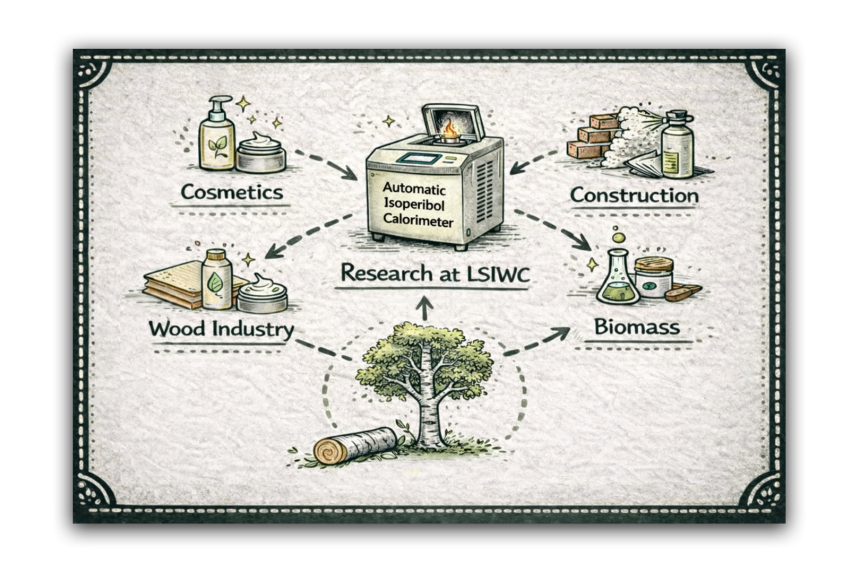
What do cosmetic cream, home insulation foam and plywood have in common? All of these products can use compounds derived from birch bark. Researchers at the Latvian State Institute of Wood Chemistry, working together with industrial partners, are investigating how these natural compounds can be transformed into new cosmetic ingredients, insulation materials and environmentally friendly binders that can replace fossil-based raw materials.
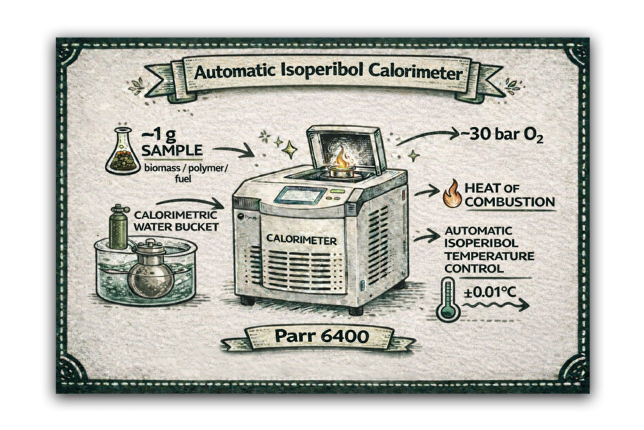
In the modern bioeconomy, the ability to use natural resources efficiently and to develop new materials from woody biomass is becoming increasingly important. Developing such solutions requires precise scientific research into the chemical and energetic properties of materials. At the Latvian State Institute of Wood Chemistry (LSIWC), this work is supported by modern analytical equipment, including an automatic calorimeter (6400 Automatic Isoperibol Calorimeter, Parr Instrument Company, USA). It is one of the first instruments acquired within the project “Development of the Bioeconomy Excellence Centre at the Latvian State Institute of Wood Chemistry (WoodChemPlus)”, aimed at strengthening the institute’s research infrastructure in the areas of Latvia’s Smart Specialisation Strategy (Research and Innovation Strategy for Smart Specialisation – RIS3).
Within the WoodChemPlus project, the Latvian State Institute of Wood Chemistry (LSIWC) is gradually strengthening its scientific infrastructure. The aim of the project is to expand research capacity in three RIS3 priority areas: bioeconomy, smart materials and biomedicine.
In May 2025, the institute acquired the first piece of equipment under the project – an automatic calorimeter that allows precise determination of the heat energy released by materials during combustion. Instruments of this type operate based on the oxygen bomb calorimetry principle, where a sample is burned in a controlled oxygen atmosphere and the released energy is calculated from the temperature change in the calorimeter.
These measurements are essential both for studying the chemical composition of materials and for developing new bioeconomy products.
Calorimetry in Wood Chemistry Research
At the LSIWC, the calorimeter is used in several research projects investigating compounds derived from birch bark extractives and their potential applications in industrial materials.
Use of Suberinic Acids in Polyurethane Materials
Calorimetry is one of the methods used to characterise new bio-based materials and evaluate their thermal properties. By analysing energy release and heat effects in different processes, researchers can obtain additional information about material composition, reaction pathways and their potential for practical applications.
This approach is also applied in the European Regional Development Fund (ERDF) project Upcycling of extracted birch outer bark into innovative bio-based polyol suitable for industrial application of rigid polyurethane insulation foam (SAMPUR). The project focuses on developing a technology that enables the production of bio-polyols from suberinic acids obtained from birch bark for the manufacturing of polyurethane insulation foams.
The project was launched on 1 July 2025, with LSIWC as the lead partner in collaboration with Ritols Ltd. and Polylabs Ltd. Its objective is to develop an innovative zero-waste technology that enables the use of wood industry by-products for the development of new materials.
During the project, researchers investigate the depolymerisation of birch bark and the extraction of suberinic acid mixtures, as well as the conversion of these compounds into low-viscosity polyols. The obtained polyols are tested as raw materials for the synthesis of rigid polyurethane insulation materials, while their chemical and physical properties are characterised using various instrumental analytical methods.
The results of this research contribute to the development of a new generation of bio-based insulation materials that could reduce the use of fossil-based raw materials in the production of construction materials.
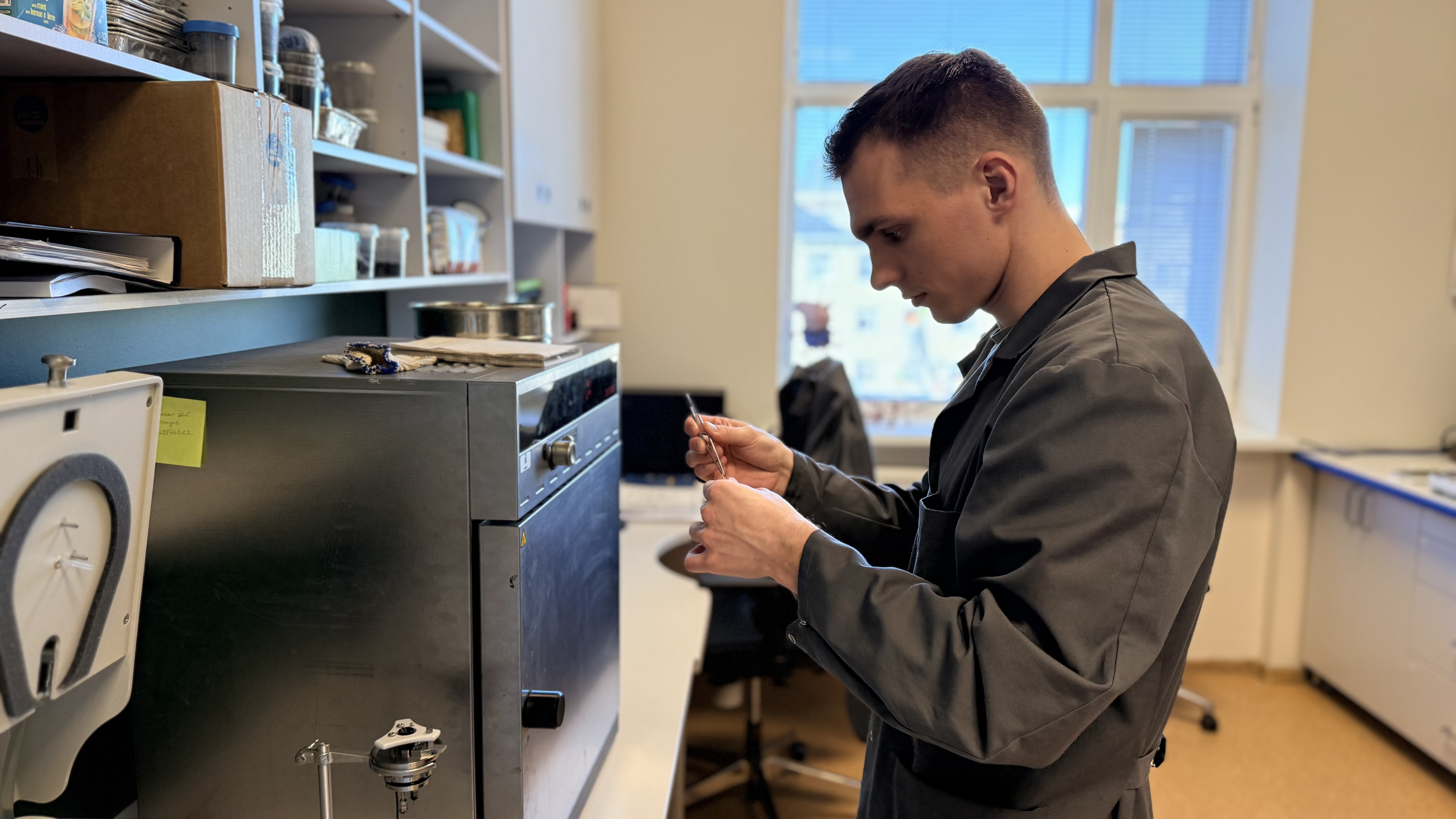
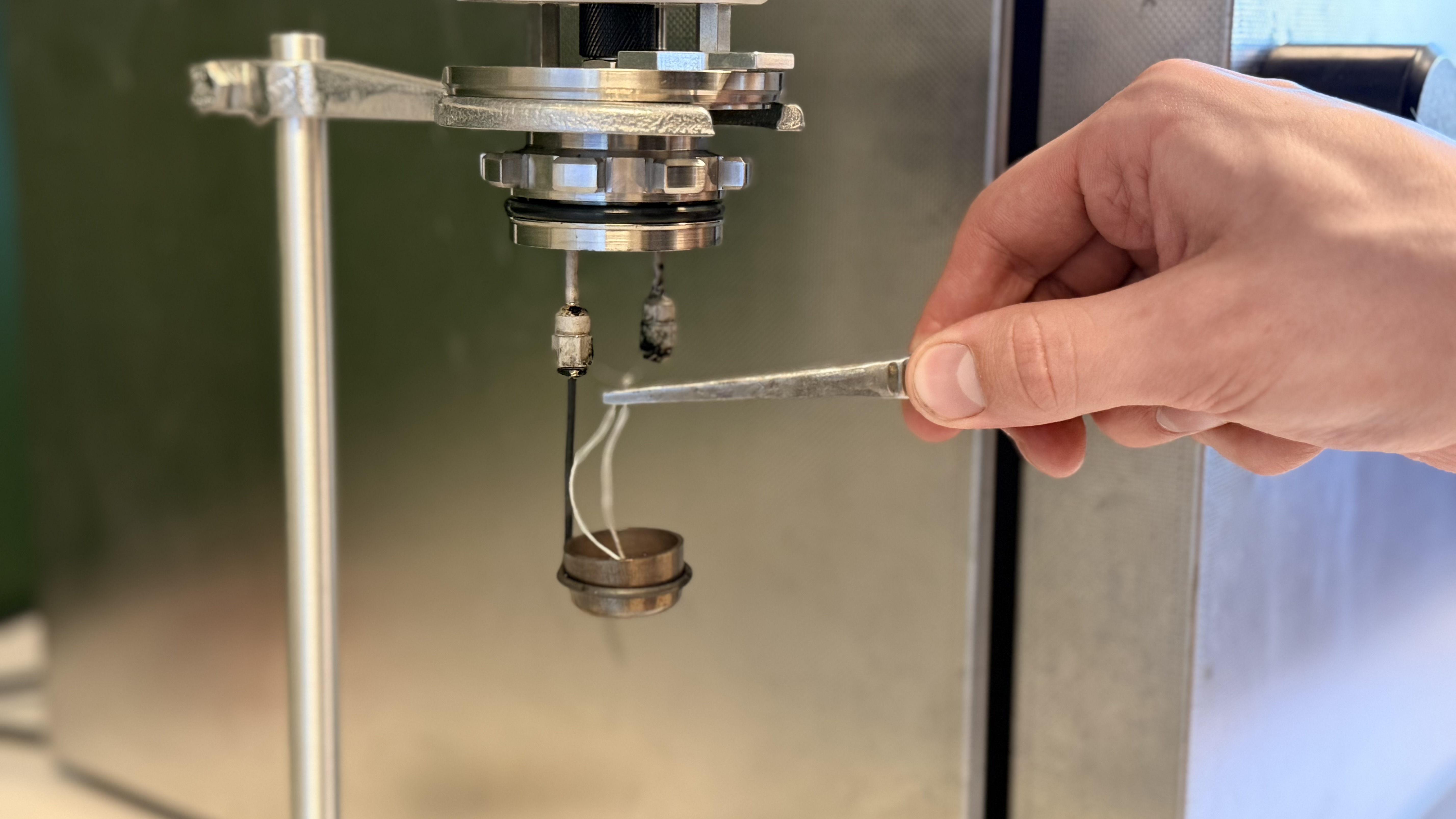
Mg. chem. Kalvis Liepiņš, Research Assistant at the Biorefinery Laboratory, prepares a sample for insertion into the calorimeter
Research on Betulin and Extractives for Cosmetic Materials
Since 1 May 2025, the LSIWC, together with the companies Labrains Ltd. and Latvijas Finieris JSC, has been implementing an interdisciplinary ERDF-supported project titled Development of innovative body skincare products and unique cosmetic raw material, stabilized with multifunctional particles of birch outer bark extractives. The aim of the project is to develop innovative skincare products and unique cosmetic ingredients using microscale particles of birch bark extractives.
During the project, three new product prototypes will be developed:
a sunscreen cream (SPF ~30),
moisturizing body creams,
moisturizing facial creams.
These will be the first cosmetic products of this type to use specially adapted birch bark extractive particles designed to meet the requirements of the cosmetics industry and to be easily incorporated into cosmetic formulations. This approach makes it possible to replace potentially harmful synthetic emulsifiers with a natural and more resource-efficient alternative.
As a result, so-called Pickering emulsions are obtained, in which birch bark extractive particles stabilise the emulsion through a mechanism different from that of conventional synthetic emulsifiers. To better understand the properties of these systems, researchers analyse the quality of birch bark, the stability and structure of the emulsions, and the physicochemical properties of the extractives used, applying various analytical methods, including calorimetry.
Dr. sc. ing. Aigars Pāže, leading researcher of the Biorefinery Laboratory, notes:
“This project will make a significant contribution both to Latvia’s bioeconomy and to global efforts to move towards more environmentally friendly and resource-efficient production. The results of the project will generate new knowledge and technologies that will be useful not only for the cosmetics sector but also for other industries related to birch processing.”
In both studies, calorimetry helps to characterise the quality of birch bark based on its energetic properties and provides additional information about the potential of the raw material for the development of cosmetic products and insulation materials.
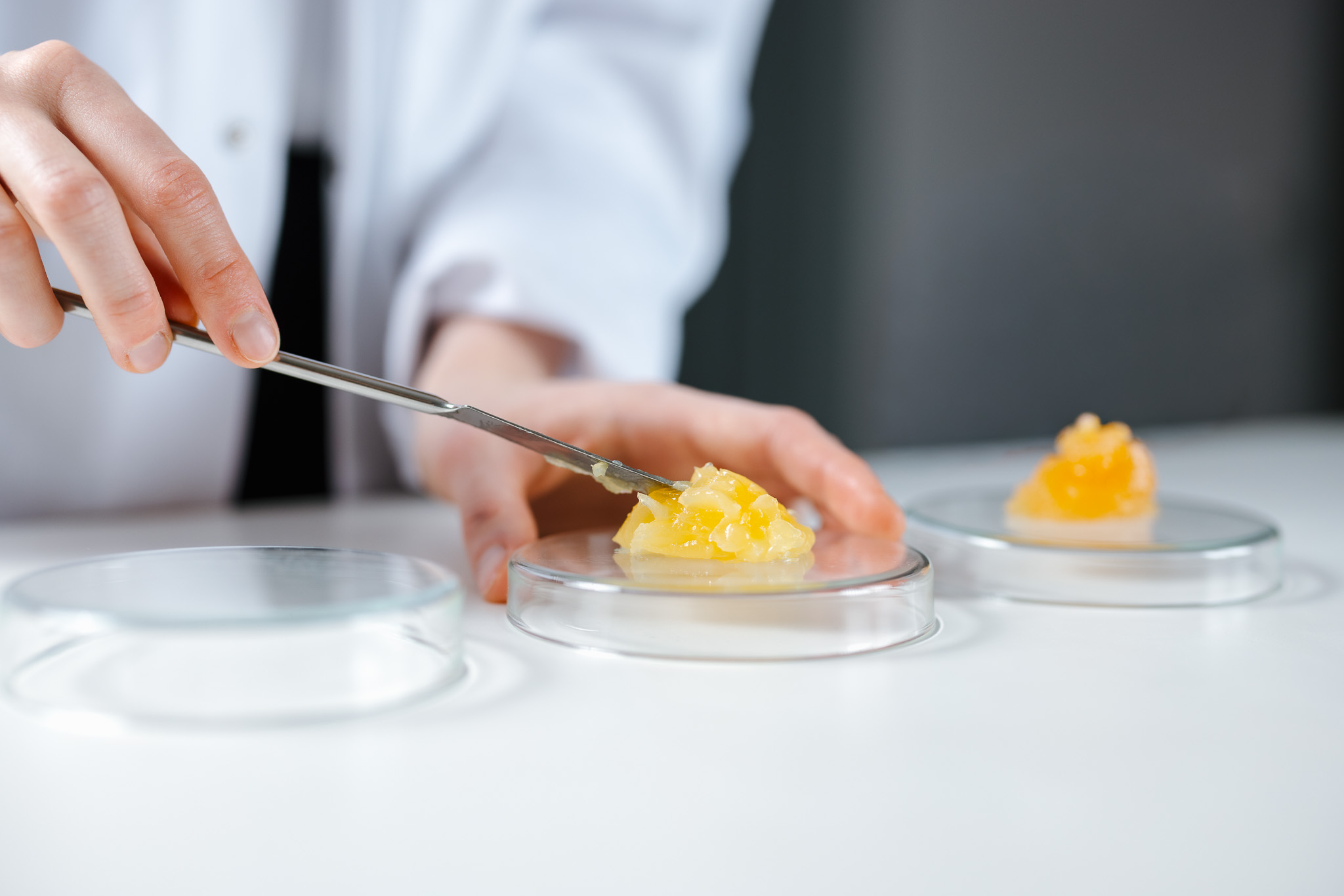
Photo: Latvijas Finieris
Cooperation with Industry: Research with Latvijas Finieris
The calorimeter is also actively used in contract research projects with Latvijas Finieris JSC, where researchers are developing bio-based binders for plywood production. Within these studies, scientists from the LSIWC have demonstrated for the first time on an industrial scale that suberinic acids obtained through the depolymerisation of suberin can be used as an environmentally friendly binder for the production of moisture-resistant plywood, particle boards and fibreboards, as well as for wood surface coatings and impregnation. The research has also been included among the Latvian Academy of Sciences’ most significant scientific achievements of 2025.
The authors of the study are Dr. sc. ing. Jānis Rižikovs, Dr. sc. ing. Aigars Pāže, PhD Daniela Godiņa, Mg. sc. ing. Rūdolfs Bērziņš, Mg. chem. Kalvis Liepiņš, and Mg. sc. ing. Guntis Sosins, together with industry representatives from Latvijas Finieris JSC: Ainārs Bobulis, Artūrs Raimonds Feldmanis, and Ketrina Plantus.
The significance of this work is reflected in 15 scientific publications, the Materials Horizons Best Paper Award, one patent, and a sold licence for the use of intellectual property. International collaboration with Stockholm University, NIBIO, INNORENEW, Warsaw University of Life Sciences, and VTT Technical Research Centre of Finland further demonstrates the relevance of Latvian innovations at the European level.
Dr. sc. ing. Jānis Rižikovs, Head of the Biorefinery Laboratory, explains:
“In cooperation with Latvijas Finieris, we are carrying out contract research focused on optimising plywood binders by replacing fossil-based raw materials and improving resource efficiency. Within this research, several tasks are being carried out. One of them involves industrial studies on the production of suberinic acids in an aqueous medium from both extracted and non-extracted birch bark, resulting in binders for plywood production, as well as in ethanol medium to obtain raw materials for anti-swelling coatings.
Further tasks focus on industrial studies aimed at adapting suberinic acids for plywood bonding, implemented in close cooperation with representatives of Latvijas Finieris. These include optimisation of binder application processes and their adaptation for industrial-scale production.
In addition, the possibilities for processing by-products obtained during suberinic acid production are evaluated for their further use in mineral fertilisers and water softening. We have also conducted preliminary research on the use of suberinic acids obtained in ethanol medium for anti-swelling coatings in laminated plywood, which has shown promising results.”
In these ERDF-supported studies, calorimetry is used to determine the birch bark content prior to extraction and depolymerisation and to characterise the raw material used, which is essential for ensuring stable and reproducible material quality.
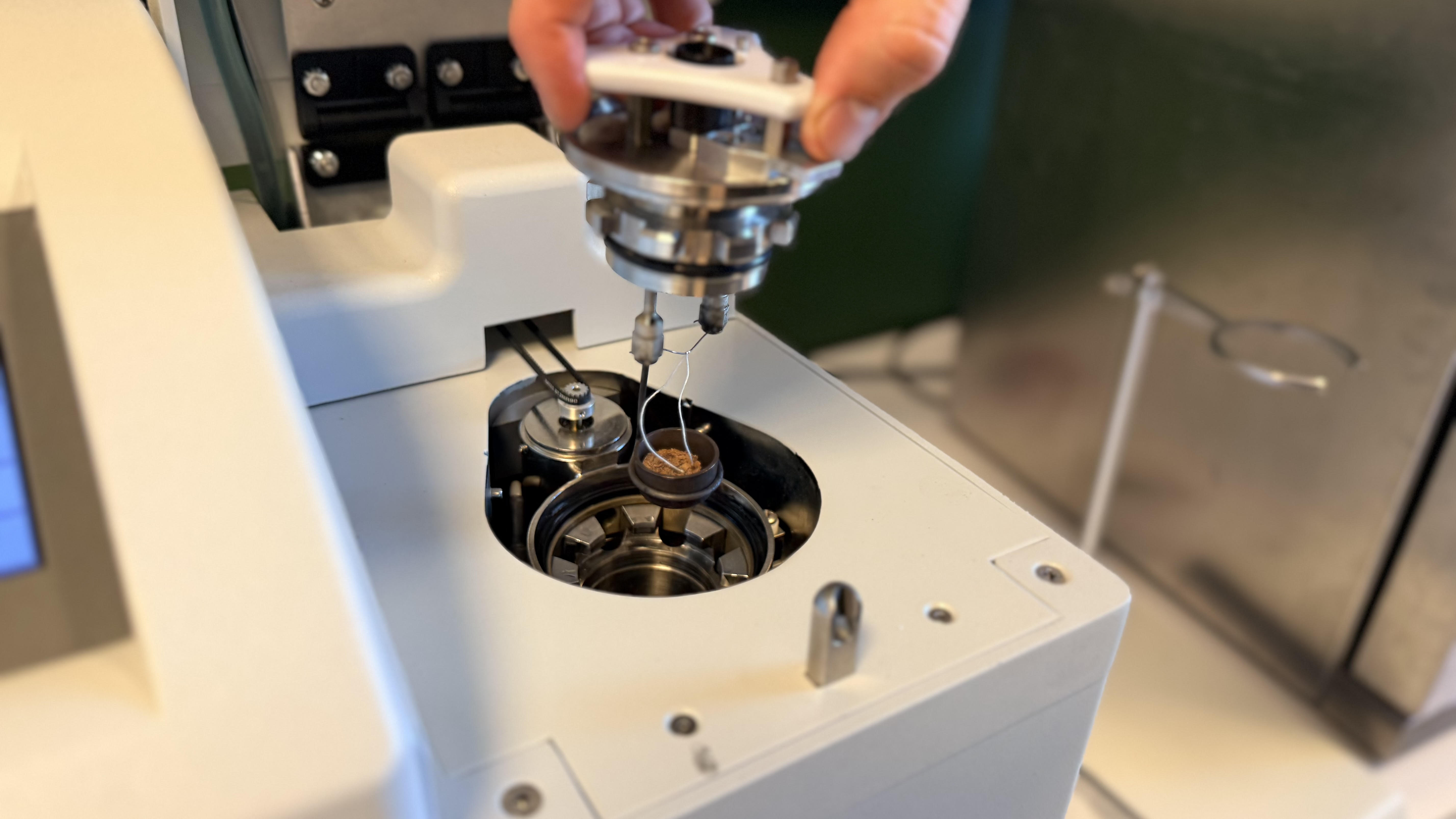
Placing the sample into the calorimeter
Research Infrastructure for the Development of the Bioeconomy
The calorimeter is one of nine modern laboratory instruments that will be acquired within the WoodChemPlus project. This infrastructure will enable the development of new technologies for processing woody biomass and the creation of environmentally friendly materials for construction, chemistry and cosmetics, while also strengthening the international competitiveness of the Latvian State Institute of Wood Chemistry (LSIWC) in bioeconomy research. Modern analytical equipment is a key prerequisite for transforming knowledge generated in the laboratory into new technologies and products.
The project Development of the Bioeconomy Centre of Excellence at the Latvian State Institute of Wood Chemistry (WoodChemPlus) is implemented within the European Union Cohesion Policy programme activity 1.1.1.2 “RIS3 Research and Innovation Centres.” The programme in Latvia is coordinated by the Ministry of Education and Science, which shapes national science and innovation policy and promotes the development of research infrastructure in strategically important RIS3 priority areas.