LSIWC researchers showcase a fully automated bioreactor prototype for producing a microbiological preparation under farm conditions
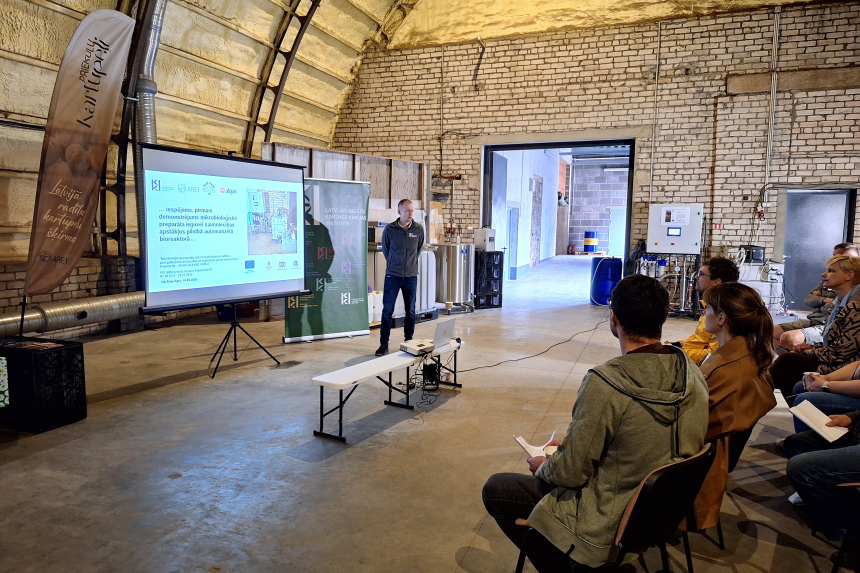
On 16 June, a fully automated bioreactor prototype for producing a microbiological preparation under farm conditions was demonstrated at Aloja Agro Ltd. as part of the Subt4Potato project. Developed by the Bioengineering Laboratory of the Latvian State Institute of Wood Chemistry (LSIWC), the prototype represents another step towards enabling the production of microbiological preparations under farm conditions.
The Subt4Potato project explores the production and application of a novel microbiological preparation containing Bacillus subtilis MSCL 1441 bacteria for horticulture and crop farming. The research aims to develop sustainable microbiological solutions that can promote plant growth, improve nutrient availability and enhance overall plant health.
During the demonstration, Oskars Grīgs and his colleagues introduced the operating principles of the bioreactor and explained the production process of the microbiological preparation. Participants also had the opportunity to observe the technology in operation and discuss its potential applications in agriculture.
"Our goal is not only to develop new technologies in the laboratory but also to create the conditions for their practical implementation on farms and within agricultural cooperatives. Demonstrations like this allow us to evaluate the technology under real-world conditions while gathering valuable feedback from industry stakeholders," says Oskars Grīgs, researcher at the Latvian State Institute of Wood Chemistry.
The demonstration was also featured in the Latvian regional television programme "Limbaži rada un dara" on ReTV.
About the project
The project "Production and application of a microbiological preparation under farm conditions for increasing yield in horticulture and crop farming enterprises (Subt4Potato)" aims to explore the production and application of a novel microbiological preparation containing Bacillus subtilis MSCL 1441 bacteria. The goal is to increase crop productivity while reducing production costs associated with alternative fertilisers and plant protection products through the development of technologies suitable for use under farm conditions.
The project is coordinated by the Latvian State Institute of Wood Chemistry in collaboration with the Institute of Agricultural Resources and Economics (AREI), Aloja Agro Ltd., and ALOJA-STARKELSEN Ltd.