How Can Wood Be Used to Create an Implant for Bone Fixation? An Interview with Mārtiņš Andžs
The OsteoWood project, developed within the BioPhoT platform, is exploring a new solution for bone fixation – a material made from specially densified birch wood that could become an alternative to traditional metal implants.
Unlike metal, which is much stiffer than bone, the aim of OsteoWood is to develop an implant that shares the load with the bone and allows it to maintain its natural function during healing.
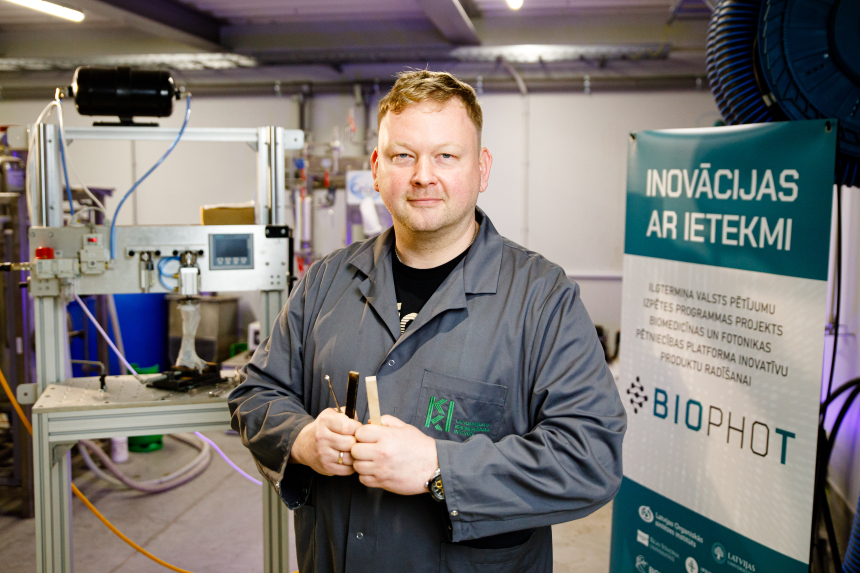
But how can this idea be turned into a real implant prototype? Mārtiņš Andžs, Ph.D., Leading Researcher at the Latvian State Institute of Wood Chemistry, talks about his work on the project, its technical challenges and the unusual tasks that arise on the way from wood to an implant.
What is your role in the OsteoWood project?
My primary task is to develop the OsteoWood implant prototype – a special wooden screw that could be used to fix a broken bone. This involves densifying the wood, then determining its mechanical properties and doing everything possible to ultimately produce a super-strong screw with a special thread that could be screwed into bone.
Figuratively speaking, one of my roles is to be a “bone breaker.” We break the bones of different animals for testing. In order to screw something together, the bones we will use for testing first have to be broken, and they always need to be broken in the same way so that they can be compared with each other.
What is the biggest technical challenge in the OsteoWood project?
This project is already a challenge in itself, not only from a philosophical but also from a technological perspective. The task is to achieve something that no one has achieved before. To densify wood, or “erase a piece of wood’s memory that it was once part of a log,” so that it no longer swells or changes its dimensions. And then – to create the thread needed for the screw.
All of this has to be achieved in a very small size – 3 to 6 mm in diameter – while also ensuring that the material is harmless to cells and humans and does not release any unwanted compounds. Plus, it needs to be strong enough for the screw to hold the bone together until it heals.
This is an extremely multidisciplinary and challenging piece of work, and that is why science is exciting.
What do you find most interesting about the process?
Thinking, looking for solutions, experimenting and achieving a result.
Here is one example among many from this project. How many people know how to break different bones so that they break in the same way under torsion (the bone breaks as it twists under a torsional force)? How do you do that?
After several attempts, I developed a “bone breaker” consisting of a board and special clamps. By applying force evenly, the bones broke according to the microsurgeons’ requirements for the ideal fracture.
At moments like these, you can appreciate how a bone is both fragile and strong at the same time.
A big thank you to Mārtiņš Andžs for his openness and for giving us a glimpse into the everyday work of a researcher and behind the scenes of the OsteoWood project!