From a Bold Idea to an ERC Interview: A Conversation with LSIWC Researcher Laura Andže
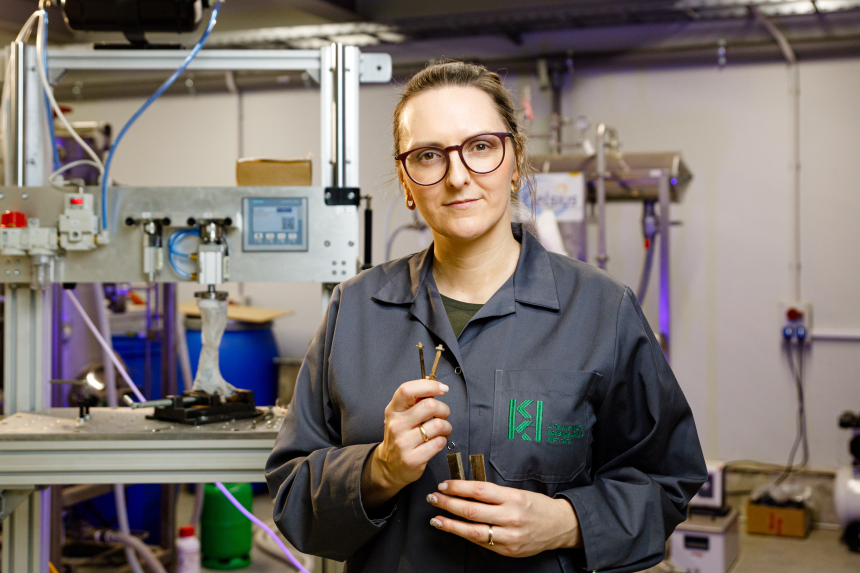
A few years ago, the idea of creating a new generation of load-bearing biomaterials from wood would have seemed almost unbelievable. Yet this very idea has taken Laura Andže, Leading Researcher at the Latvian State Institute of Wood Chemistry (LSIWC), to the final stage of the European Research Council (ERC) Starting Grant competition – the interview.
The ERC Starting Grant is one of Europe's most prestigious research grants for early-career researchers establishing their independent research careers and pursuing ambitious, high-risk scientific ideas. The interview represented the second and final stage of the selection process.
Laura took part in the competition with the OsteoWood project. The ERC project idea grew out of insights gained during the development of the OsteoWood project within the BioPhoT platform and is based on a new scientific hypothesis concerning the interactions between wood, biopolymers, and suberinic acids. The project aims to understand whether these interactions can be harnessed to create a new generation of load-bearing biomaterials for medical applications.
We spoke with Laura about the nearly year-long journey of preparing the ERC proposal, the path to the interview, and the insights she gained from the experience as a researcher.
You spent almost a year preparing your ERC proposal. How did your perspective on the idea evolve during that time?
When I first began writing the ERC proposal, my attention was mainly focused on the end material – whether it would be possible to create a load-bearing implant from modified wood. However, as the project developed, particularly through discussions with ERC consultants and while preparing for the interview, my perspective changed significantly. I realised that the true value of the project was not simply the new material itself, but the fundamental scientific questions it enabled us to ask.
Every technological step became a research question in its own right: How does pre-treatment alter the wood cell wall and affect polymer penetration? Which fractions of suberinic acids are capable of penetrating the wood, and how do they interact with wood polymers and chitosan? How are bonds formed between these components, and how do they determine the material's mechanical properties, swelling behaviour, and biological performance? As I worked on the proposal, it became increasingly clear that the development process itself had become a platform for seeking answers to entirely new scientific questions.
At the same time, I had to immerse myself deeply in the field of biomaterials and implant research – learning about methods, requirements, and aspects that we rarely consider in everyday wood science, such as long-term behaviour under physiological conditions or the interaction between materials and living tissues. For me, that is what made this past year so valuable.
How did you feel when you learned that you had been invited to the interview?
It was a very special moment. At the time, I was working with one of my undergraduate students on her thesis proposal, discussing the research hypothesis and objectives. At that very moment, an email from the ERC arrived.
When I opened it, my first thought was: "Well, this is probably a rejection." But as I kept reading, I realised I had actually been invited to the interview.
To be honest, I read the letter several times because at first I simply couldn't believe it. Of course, I was incredibly happy. I immediately ran to tell my colleagues, returned to my student, and couldn't stop smiling for quite a while. But alongside the excitement came something else – the feeling that an idea I had believed in for several years had received truly significant international recognition.
Many people congratulated me, saying that reaching the interview stage alone was already a remarkable achievement. For what was probably the first time during this project, I felt a strong sense of confidence that this idea genuinely deserved to stand among the very best.
The excitement, however, quickly gave way to work. An intensive period of preparation followed – meetings with ERC consultants, countless mock interviews, challenging questions from colleagues, and many hours spent looking at the project from as many different perspectives as possible.
What has this process given you as a researcher?
Perhaps the most important thing is that I have learned to think about scientific projects in a completely different way. Until now, most of my experience had been with projects where practical application needed to be demonstrated very quickly – what could be used within a year, what problem would be solved, and where the technology could be implemented.
The ERC process made me start from a completely different question – not what we will gain, but what new knowledge we are currently missing.
While writing the proposal and preparing for the interview, I realised that a truly strong scientific idea is not simply about an excellent end result or a promising technology. It is an idea that asks fundamental questions and generates new knowledge. Throughout this process, I learned to formulate scientific questions much more clearly, think more broadly, and build a project on multiple levels – combining a clear practical objective with a solid foundation in fundamental research.
From the outside, fundamental research may sometimes seem to focus on very narrow or even insignificant questions. In reality, however, it is precisely these small answers that become the foundation for the next major discoveries. Nothing in science emerges out of nowhere – every new solution is built upon previously acquired knowledge, and our role is to expand that body of knowledge. Only then do technologies, products, and practical applications emerge.
For me, this has been the greatest outcome of the past year – not only a much deeper understanding of my own research, but also an entirely different perspective on how truly ambitious science is created. Regardless of the final outcome, this has been one of the most valuable professional experiences of my career.
Our sincere thanks to Laura for sharing her experience and reflections.