6th Congress of Baltic Microbiologists (CBM 2025)

The most significant microbiology event in the Baltic region — the 6th Congress of Baltic Microbiologists (CBM 2025) — gathered around 100 researchers this autumn from six countries: Latvia, Lithuania, Estonia, Germany, Italy, the Netherlands, and the USA. This was already the sixth meeting of Baltic microbiologists since the series began in Riga in 2012. After several successful events across the Baltics, the congress returned to the Latvian capital in 2025.
Over three days, the congress presented a cohesive and contemporary narrative of microbiological research and innovation — spanning from medical and viral biology to environmental microbiology, biotechnology, microbial diversity, and the valorisation of biological waste. The goal of CBM 2025 was to promote interdisciplinary dialogue and inspire new collaborations among scientists and practitioners across the region.
The scientific program of CBM 2025 covered a broad and diverse landscape of microbiology, uniting several interrelated research fields. The thematic sessions included medical and antimicrobial microbiology, focusing on microbial resistance and new therapeutic strategies; virology and phage research, highlighting the potential of phage therapy and biocontrol; and environmental microbiology and biostability, exploring the role of microorganisms in water, soil, and waste processing.
The program included oral presentations, lightning talks, poster sessions, and an abstract book summarizing the latest research findings. Participants explored state-of-the-art methodologies such as genomic analysis, modelling, synthetic communities, electrochemistry, and advanced imaging technologies.
The Latvian State Institute of Wood Chemistry was represented at the congress by three researchers — Dr. Ilze Irbe, Dr. Oskars Bikovens, and Mikus Kampuss.
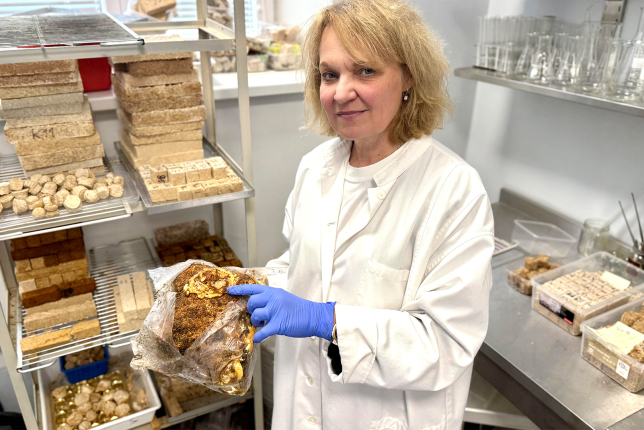
Dr. Ilze Irbe presented her research titled “Valorisation of low-value plant biomass residues for the development of mycelium-based biocomposites.” The study analysed the physical and mechanical properties of mycelium biocomposites grown from Trametes versicolor on birch sanding dust and wheat straw substrates. The results showed that birch-based composites demonstrated higher mechanical strength and moisture resistance, making them promising candidates for the development of bio-based materials. At the same time, their high water absorption capacity indicated potential for use in heavy metal biosorption.

Dr. Oskars Bikovens delivered a presentation titled “Mycelium biocomposites derived from agricultural and wood processing by-products with magnetic properties as potential biosorbents.” His research focuses on developing magnetic mycelium biocomposites containing magnetite nano- and microparticles capable of adsorbing heavy metals from water and being separated magnetically without filtration. The results revealed that birch-based substrates ensured significantly higher magnetic activity compared to wheat straw, positioning them as promising materials for magnetic biosorbent development.

Mikus Kampuss presented his study “Effect of substrate composition and chitosan coating on the properties of T. versicolor mycelium composites.” The research examined how substrate composition and chitosan coating affect mycelium composite properties. Wheat straw promoted more intensive mycelium growth, while bending strength remained similar across samples. In contrast, pine sawdust provided higher compressive strength. The chitosan coating substantially reduced water absorption but increased sensitivity to air humidity, revealing the balance between moisture resistance and hygroscopicity.

CBM 2025 was organized by the Institute of Microbiology and Biotechnology of the University of Latvia, in cooperation with partner organizations across the Baltic States. The mission of the congress was to create a platform where science, ideas, and people meet — to shape the future of microbiology in the Baltic region and beyond.