SugarPot
Project summary
The SugarPot project aims to elucidate the various anhydrosugar formation mechanisms during pyrolysis and to optimise the lignocellulosic biomass pre-treatment and pyrolysis technology for a high yield of recoverable platform chemicals.
The specific scientific objectives of the project are related to the thermochemical decomposition of cellulose and the equilibrium between monosaccharide derivatives and their isomers as pyrolysis products under different pre-treatment conditions, as well as the extraction and purification of the obtained products. A strong emphasis will be put on the greenness of the proposed methods, from analytical to preparative. To achieve the goals of the proposal, the conditions of pre-treatment of different biomass types and reference carbohydrates will be investigated by analytical pyrolysis and gas chromatography-mass spectrometry. Further on, bio-oil samples with an optimised anhydrosugar yield will be obtained in a continuous flow pyrolysis reactor. The bio-oil will be characterised by a combination of modern chemical analytical methods, and then separated into fractions to recover specific products.
The technologies will be developed in line with a biorefinery approach, to maximally add value to secondary forestry biomass, and to reduce wastes, which is an important contribution to the Latvian RIS3 field “Knowledge-intensive bioeconomy”.
Call: Specific Objective 1.1.1 “Strengthening of Research and Innovation Capacities and Introduction of Advanced Technologies in the Common R&D System” of the European Union's Cohesion Policy Programme for 2021-2027.
Activity: 1.1.1.9 “Post-doctoral Research”
Project duration: 36 months.
Total eligible costs of the project: 184 140 EUR, including funding from the European Regional Development Fund in amount of 85 % – 156 519 EUR.
Project partners
- Leading partner/coordinator: Latvian State Institute of Wood Chemistry
- Cooperation partner: University of Copenhagen
Project implementation
30.04.2026.
Project progress report for the period 01.01.2026. - 30.01.2026.
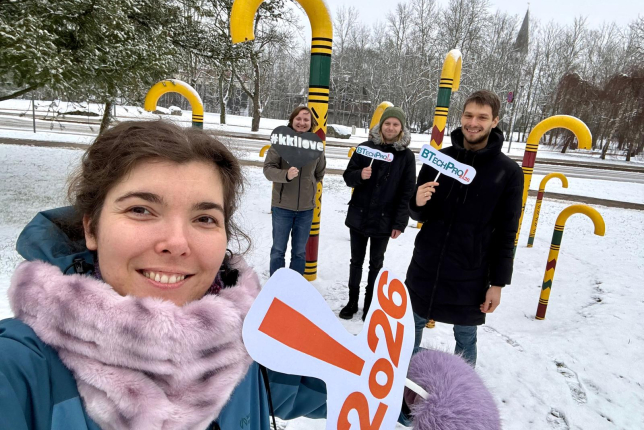
In the first months of 2026, mobility activities were carried out at the project partner Department of Plant and Environmental Research at the University of Copenhagen (UCPH). Over the course of five weeks at UCPH, the formal training course "Advanced Mass Spectrometry" was completed and skills were advanced in working with specific analytical methods and data processing software.
In March, a mobility activity was carried out at the University of Chemistry and Technology in Prague to initiate collaborative research on the catalytic conversion of bio-oil fractions obtained in the project, which will be useful in future research phases.
As part of the first work package, research into the mechanisms of anhydrosugar formation is continuing, involving the analytical pyrolysis of various reference materials in the presence of sulfuric acid at different concentrations. The results of the analytical pyrolysis are being summarised for presentation in June at the international conference "Pyro2026."
30.12.2025.
Project progress report for the period 01.07.2025. - 31.12.2025.
During the first six months of the project, the work package "Optimising pre-treatment and pyrolysis of lignocellulosic biomass", was started, which involved analytical pyrolysis of both a series of model substances and lignocellulose obtained from biorefining processes.
- To study the mechanisms of anhydrosugar formation, analytical pyrolysis of various reference materials—glucose, fructose, cellobiose, sucrose, levoglucosan, starch, cellulose—was performed by changing the sulfuric acid concentration and evaluating the effect of acid on the formation trends of various anhydrosugars. The formation of the following anhydrosugars was observed: levoglucosan, 1,6-anhydro-beta-D-glucofuranose, 1,4;3,6-dianhydro-alpha-D-glucopyranose, levoglucosenone, as well as other products of thermochemical degradation of carbohydrates. The composition of the pyrolysis products was influenced by both the nature of the raw materials themselves and the concentration of the added sulfuric acid.
- Analytical pyrolysis tests were also performed on birch wood and lignocellulose obtained as residues from two birch biorefining processes: 1) sulfuric acid-catalyzed steam explosion pretreatment (Nova Pangaea Technologies Ltd.); 2) phosphoric acid-catalyzed furfural production technology (Latvian State Institute of Wood Chemistry). Analytical pyrolysis at 350 °C and 500 °C provided insight into the formation trends of levoglucosan and levoglucosenone.
The research will continue, focusing on the impact of pre-treatment and catalysts on the formation of anhydrosugars, in order to find ways to simultaneously obtain several valuable chemical compounds as biorefining products. The results of the preliminary tests have been presented at the conference PYROLIQ III – 2025: Pyrolysis and Liquefaction of Biomass and Wastes (Preliminary investigation of the production of 1,6-anhydro-ꞵ-d-glucofuranose by wood pyrolysis).
Several mobility and networking activities have been carried out within the framework of the project:
- Participation in the "Green Chemistry Postgraduate Summer School 2025"
- Invited lecture "Putting "bio" in plastics: from renewable feedstocks to advanced end-of-life management strategies" at Hamburg University of Applied Sciences during the workshop "Young Researchers for a Plastic Free Baltic Sea Region"
- Participation in the Horizon Europe brokerage event “Bio-based Future Connect” related to the new Cluster 6 calls
- The first mobility phase was carried out at the project's cooperation partners at the University of Copenhagen, and training began in the course "Advanced mass spectrometry"
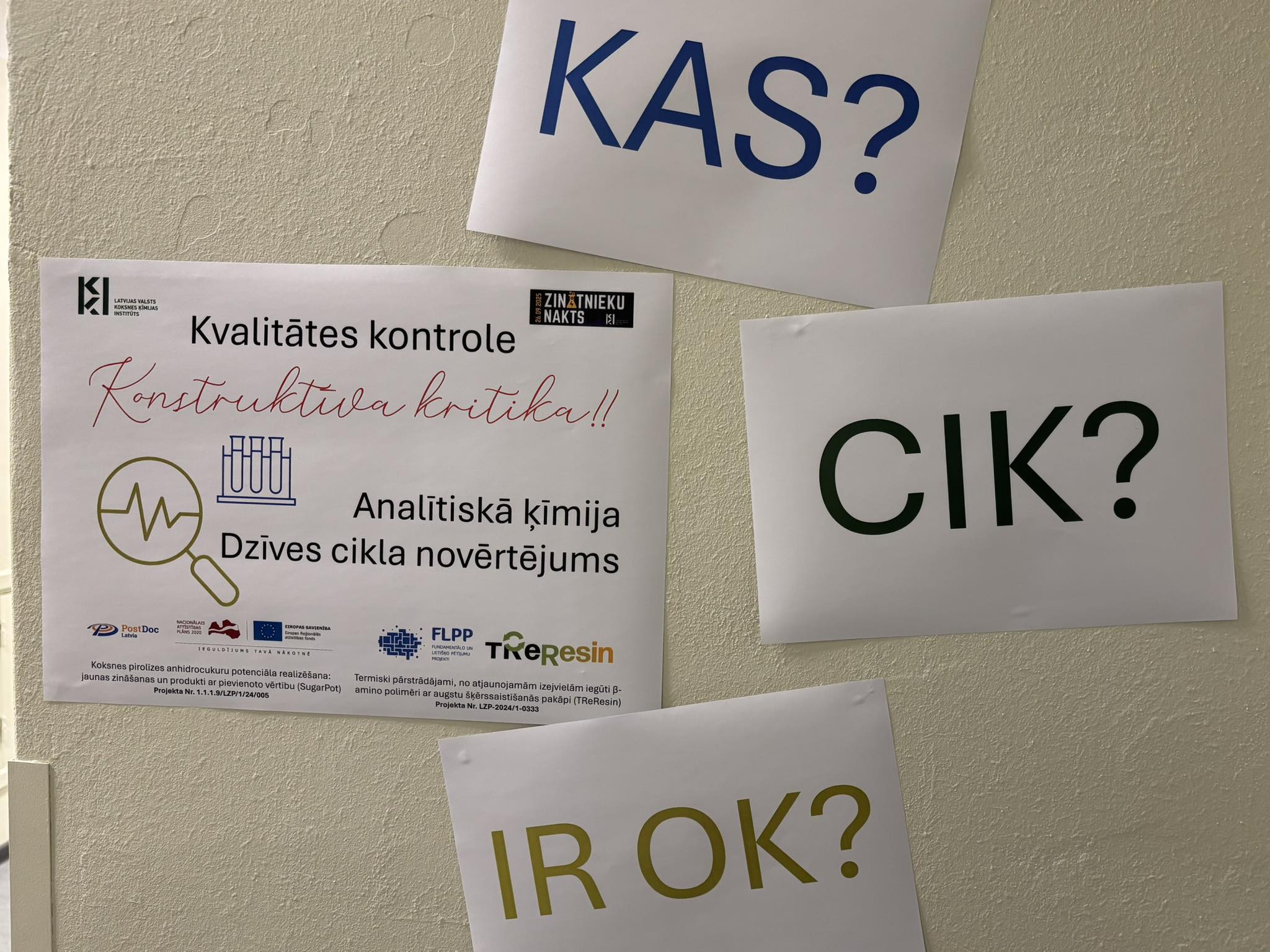
The 4th work package "Management and Communication & dissemination" has also started. Latest information about the project can be found by following postdoctoral researcher Kristīne Meile's posts on LinkedIn and Facebook. Face-to-face communication activities have taken place, such as participation in Researchers' Night 2025 events, a guest lecture at the University of Latvia, and visits to primary school pupils during career week. A "Communication, Dissemination, and Exploitation (CDE) Plan" has been created for the project results.
01.07.2025.
Implementation of the project begun.