BirchSorb
The aim of the project is to synthesize bio-based polymer sorbents from birch outer bark extractives (triterpenes), to be used as stationary phases and applied in separation and purification processes, particularly in the fields of liquid chromatography (LC) and solid-phase extraction (SPE). The research falls within the scope of industrial research, covering applied studies and innovation activities. The project, “Synthesis of Bio-Based Polymer Sorbents from Birch Outer Bark Extractives”, aligns with the core objectives of Latvia’s Smart Specialization Strategy (RIS3), promoting a knowledge-intensive bioeconomy, as well as the development of photonics, smart materials, technologies, and engineering systems. Research on bio-based polymer sorbents is especially relevant in the fields of materials science and environmental engineering, as these sorbents offer a sustainable alternative to traditional sorbents. Bio-based polymers are biodegradable, helping to reduce environmental pollution. Current studies are focused on improving the biodegradability and optimizing the properties of these sorbents, such as ensuring high surface area and porosity.
As part of the project’s mobility activities, a two-month research visit is planned to the Department of Chemistry at Uppsala University in Sweden, where expertise will be developed in testing bio-based sorbents using advanced chromatographic and mass spectrometric methods. This mobility will make a significant contribution to the quality of the research and the development of international collaboration, as well as lay the foundation for future joint projects and technological excellence.

Call: Specific Objective 1.1.1 “Strengthening of Research and Innovation Capacities and Introduction of Advanced Technologies in the Common R&D System” of the European Union's Cohesion Policy Programme for 2021-2027.
Activity: 1.1.1.9 “Post-doctoral Research”
Total eligible costs of the project: 184 140 EUR, including funding from the European Regional Development Fund in amount of 85 % – 156 519 EUR.
Project implementation period: 36 mēneši
Project Partners:
- Lead Partner – Latvian State Institute of Wood Chemistry
- Cooperation Partner – Uppsala University, Department of Neuroscience, Functional Pharmacology Group
Place of implementation: Latvian State Institute of Wood Chemistry
Project implementation
30.04.2026.
Project progress report for the period of 01.01.2026. – 30.04.2026.
Work package 1 “Synthesis of bio-based sorbents using different purity level birch outer bark extractives” was continued.
- Optimization of bio-sorbent synthesis conditions. Within Activity No. 1, the synthesis of bio-based polymer sorbents from birch bark extractives (betulin) and divinylbenzene (DVB) using radical-initiated polymerization was initiated. Experimental studies and analysis of the obtained sorbents revealed that the double bond present in the betulin structure does not participate in polymerization with DVB, resulting in the formation of an insufficiently stable and crosslinked polymer network. This was further confirmed by the high solubility of betulin in organic solvents, indicating insufficient chemical bonding within the polymer structure. To improve the reactivity of the system, an additional modification step was introduced — chemical modification of betulin with maleic anhydride to obtain betulin maleic diester (MaBet). This modification introduces additional reactive double bonds and promotes more effective crosslinking during radical polymerization. MaBet was synthesized both from a betulin standard compound and from birch bark extractives obtained at LSIWC containing >95% betulin. Several bio-sorbent syntheses were carried out using different MaBet and DVB ratios (0, 5, 15, 30, 50, and 100% MaBet), employing both the model compound and MaBet obtained from birch bark extractives.
- Characterization of the obtained bio-sorbents. All synthesized sorbents (MaBet-DVB) were characterized using several analytical methods, including determination of functional groups (iodine and hydroxyl values), particle size and surface morphology analysis using scanning electron microscopy (SEM), solubility testing in organic solvents, and FTIR analysis.
Project Publicity:
- Participation in Shadow Day at the Latvian State Institute of Wood Chemistry on April 1, 2026.
- Participation in the TVNET podcast “Redzi tālāk!” on March 24, 2026 (“How are laboratory-developed solutions applied in real life?” Hosted by Toms Treibergs). Available in the archive: https://www.tvnet.lv/8436609/redzi-talak-no-laboratorijas-lidz-risinajumam-jauno-zinatnieku-pieredze
- Interview for the Ministry of Education and Science experience story project about the PostDoc research on April 24, 2026 (“Daniela Godiņa: Chemistry is a very creative science!” Article by Linda Miltiņa). Available in the archive: https://www.lzp.gov.lv/lv/jaunums/daniela-godina-kimija-ir-loti-radosa-zinatne
- Interview on Latvian Radio 1 programme “Zināmais nezināmajā” on April 21, 2026 (“Birch and the application of its valuable compounds.” Hosted by Sandra Kropa). Available in the archive: https://lr1.lsm.lv/lv/raksts/zinamais-nezinamaja/berzs-un-ta-vertigo-vielu-pielietojums.a219633/
30.12.2025.
Project progress report for the period of 01.07.2025. - 31.12.2025.
Work package 1 “Synthesis of bio-based sorbents using different purity level birch outer bark extractives” was carried out.
- Birch outer bark extractive composition determination. For the preliminary experiments, the feedstock (birch outer bark extractives) was obtained using the birch bark extraction technology developed at the Latvian State Institute of Wood Chemistry. The composition of the extractives was determined using a GC-FID system. In addition, the iodine value and hydroxyl value of the extractives were measured, and FTIR, TGA, and DSC analyses were performed.
- Optimization of bio-sorbent synthesis conditions. Several solvents were tested for the sorbent synthesis—toluene, ethanol, and tetrahydrofuran (THF). The best solubility of the extractives was achieved in THF; however, it is crucial that this solvent does not contain the stabilizer BHT, as it reacts with the radical initiator preventing reaction initiation. Toluene is commonly used in this type of synthesis because it acts as an effective pore-forming agent, but in the case of birch bark extractives it was not suitable, since the extractives are not soluble in toluene. Different extractive loadings—0%, 5%, and 15%—were tested in the reaction mixture. All syntheses were carried out both with and without PVAL in the reaction system.
- Characterization of the obtained bio-sorbents. All synthesized sorbents were characterized using several analytical methods: functional group determination (iodine and hydroxyl values), size and surface morphology analysis using scanning electron microscopy (SEM), and solubility tests in organic solvents. It was found that the solvent used during synthesis significantly affects the solubility of extractives within the final sorbent. When ethanol was used in the synthesis, the extractive solubility in organic solvents was lower compared to sorbents synthesized in THF.
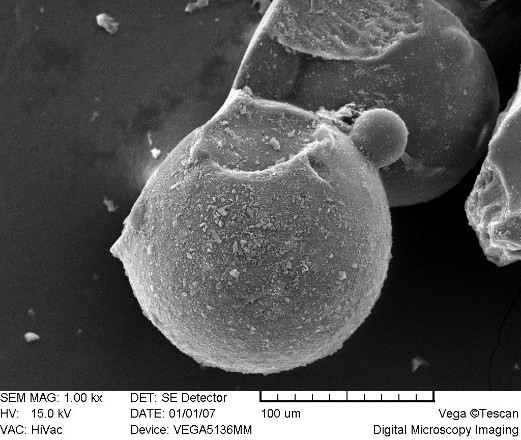
SEM image of one of the obtained bio-sorbents synthesized using THF as the solvent and 5% (w/w) added extractives
Publicity of the project:
- Interview in the newspaper “Diena”, section “Dabas diena”, in the issue of 8 December 2024 (“The Hidden Wealth in Birch Bark.” Author: Ilze Gražule).
- Interview in the magazine “Mājas Viesis”, in the issue of 9 January 2024 (“Squeezing the Birch to the Last Drop.” Author: Ilze Kuzmina).
- Interview on Radio NABA, programme Zinātnes vārdā, on 20 February 2025 (“The Chemistry Detective. Conversation with Daniela Godiņa.” Hosted by Ieva Siliņa).
- Interview on Latvian Radio 1, programme Monopols, on 5 August 2025 (“Is Scientific Work in Chemistry Creative? Conversation with researcher Daniela Godiņa.” Hosted by Kārlis Kazāks).
- Participation in Researchers’ Night 2025, engaging the public with science communication activities;
- Collaboration with the association “Latvijas Koks” during visits to schools in Latvia.
- Organized excursions at the institute, introducing pupils and students to the Latvian State Institute of Wood Chemistry and the PostDoc project.
01.07.2025.
The project has been begun.