Forest4LV results in practice: from forest health to new technologies

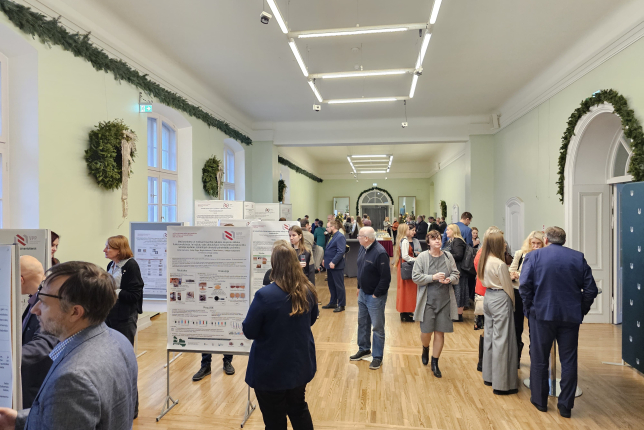
At the final conference of the State Research Programme Forest4LV, held in December, ten posters by researchers of the Latvian State Institute of Wood Chemistry (LSIWC) were presented, reflecting the diversity of research carried out within the programme — from forest ecosystem protection to the development of new bio-based materials. In this series of articles, we introduce the most significant research results and their practical relevance.
The study by Dr. sc. ing. Oskars Grīgs addresses an issue of key importance for forest health – the control of root rot – by analysing the cultivation potential of a Latvian isolate of the great white rot fungus Phlebiopsis gigantea.
Authors: O. Grīgs, I. Sutris, K. R. Gasūns (LSIWC), K. Kenigsvalde, D. Kļaviņa, T. Gaitnieks (LSFRI Silava)
In the final phase of the study, the cultivation parameters of the Phlebiopsis gigantea PG182 isolate obtained from Latvian forests were evaluated using pine shavings with different levels of wheat bran supplementation. The aim was to determine conditions that ensure reproducible spore yields for the production of a biological plant protection product to control the root rot pathogen Heterobasidion spp.
In the final phase of the study, the cultivation parameters of the Phlebiopsis gigantea PG182 isolate, obtained from Latvian forests, were evaluated using pine wood shavings supplemented with different levels of wheat bran. The aim was to determine the conditions that ensure a reproducible spore yield for the production of a biological control agent against the root-rot pathogens Heterobasidion spp.
Key indings:
- At the laboratory scale, a substrate layer of 8 cm and an initial moisture content of 60% ensured uniform mycelial development.
- The addition of 5-15% wheat bran increased the spore yield, reaching a high level on day 14 of cultivation, with the possibility - although not consistently - of achieving up to a two-fold improvement by extending cultivation to day 21; further increases in bran concentration did not improve the results.
- In larger cultivation containers (11 L and 55 L), the spore concentration was generally lower than at the smaller scale, most likely due to temperature and moisture gradients within the substrate.
- The obtained data indicate that the PG182 isolate, as a locally derived plant protection agent, is technically producible; however, achieving uniform moisture and aeration is crucial when scaling up the process.
These results provide a practical basis for further optimization of the production technology for the plant protection product and its application in forestry.
In the study by Dr. sc. ing. Dace Cīrule, the structure and physical properties of juvenile (JW) and mature (MW) birch and pine wood were compared, and the suitability of JW for glued wood products that are subjected to high humidity fluctuations was evaluated. It was found that small-dimension timbers with a high JW content are suitable to manufacture glued, non-load-bearing products. Using JW and selecting appropriate gluing parameters, it is possible to obtain glued products with good resistance to delamination under outdoor conditions.
Key findings:
- The lower density, lower shrinkage, and lower equilibrium moisture content of JW compared to MW can be an advantage in certain product segments.
- Delamination tests (EN 302-2) showed that the delamination resistance of glued products from JW can be significantly improved by adjusting the gluing parameters.
- The results imply the potential use of JW in impregnated and bent glued products.
The findings provide a factual basis for the higher-value use of small-dimension wood resources, and help define the directions of further product development.
This publication presents the first two research directions implemented within the programme. In this series of articles, we will continue to introduce the results of other studies and their potential applications, highlighting various aspects of forest and wood resource research.