Decades of Expertise and New Solutions: LSIWC Research in Pyrolysis
Thermochemical conversion of biomass is one of the long-standing research areas at the Latvian State Institute of Wood Chemistry (LSIWC). From fundamental studies of pyrolysis processes to the development of novel materials for energy storage technologies, the Institute’s researchers have been working for decades on solutions that enable more efficient use of renewable resources and reduce dependence on fossil-based feedstocks.
The latest research results were presented this summer at the 25th International Symposium on Analytical and Applied Pyrolysis (PYRO2026), held in Pisa, Italy, bringing together hundreds of researchers from around the world.
Long-standing Expertise in Pyrolysis Research
Thermochemical conversion of biomass encompasses pyrolysis, carbonization, and related technologies in which biomass is heated in the absence of oxygen to produce carbon materials and valuable chemical compounds. LSIWC has accumulated extensive expertise in this field. As early as the 1980s, researchers at the Institute developed a biorefinery approach in which hemicelluloses were converted into furfural, while the remaining lignocellulosic residue was utilized in fast pyrolysis processes to obtain liquid products with high levoglucosan content. Both furfural and levoglucosan are important renewable feedstocks for the chemical industry. Today, fast pyrolysis research continues at the Institute using reactors of original design in both scientific projects and collaborations with industrial partners.
The significance of LSIWC’s contribution is also reflected in its recognition within the international pyrolysis research community. According to researcher Kristīne Meile, international colleagues and experts in the field regularly refer to publications by Gaļina Dobele and Aivars Žūriņš, which have significantly advanced the understanding of pyrolysis processes, particularly the mechanisms of anhydrosugar formation.
From Charcoal to Supercapacitors
In addition to pyrolysis research, the Institute has developed another important area of thermochemical conversion research – the production of advanced carbon materials from biomass. Since the 1990s, LSIWC researchers have collaborated with charcoal producers and contributed to the development of carbonization technologies. Aivars Žūriņš has helped implement carbonization solutions for more than ten charcoal producers in Latvia and Estonia, and cooperation with industry continues to this day.
In recent years, the Institute’s scientific focus has increasingly shifted towards the development of structured carbon materials for batteries, supercapacitors, and other energy storage technologies. These interdisciplinary studies are carried out in close cooperation with international scientific and industrial partners.
Current Projects and Research Activities
Several ongoing projects at the Institute address both the conversion of biomass into higher-value products and the development of novel carbon materials. Among them is the postdoctoral project “SugarPot”, which aims to explain the formation of anhydrosugar isomers during biomass pyrolysis and identify pathways for producing new bio-based green chemicals and solvents from renewable resources. Another project, “ARMS”, focuses on the development of biomass-derived carbon materials for next-generation supercapacitors. Research is also carried out within the projects “LIGsp” and “HTCelect”.
Research Results Presented at PYRO2026
The 25th International Symposium on Analytical and Applied Pyrolysis (PYRO2026) took place in Pisa, Italy, from 7 to 11 June. The conference brought together 330 participants from 54 countries and is one of the leading international platforms for researchers working in pyrolysis and thermochemical conversion. Discussions covered the latest advances in pyrolysis reaction mechanisms, biomass and waste valorization, plastic recycling, advanced analytical methods, and novel materials.
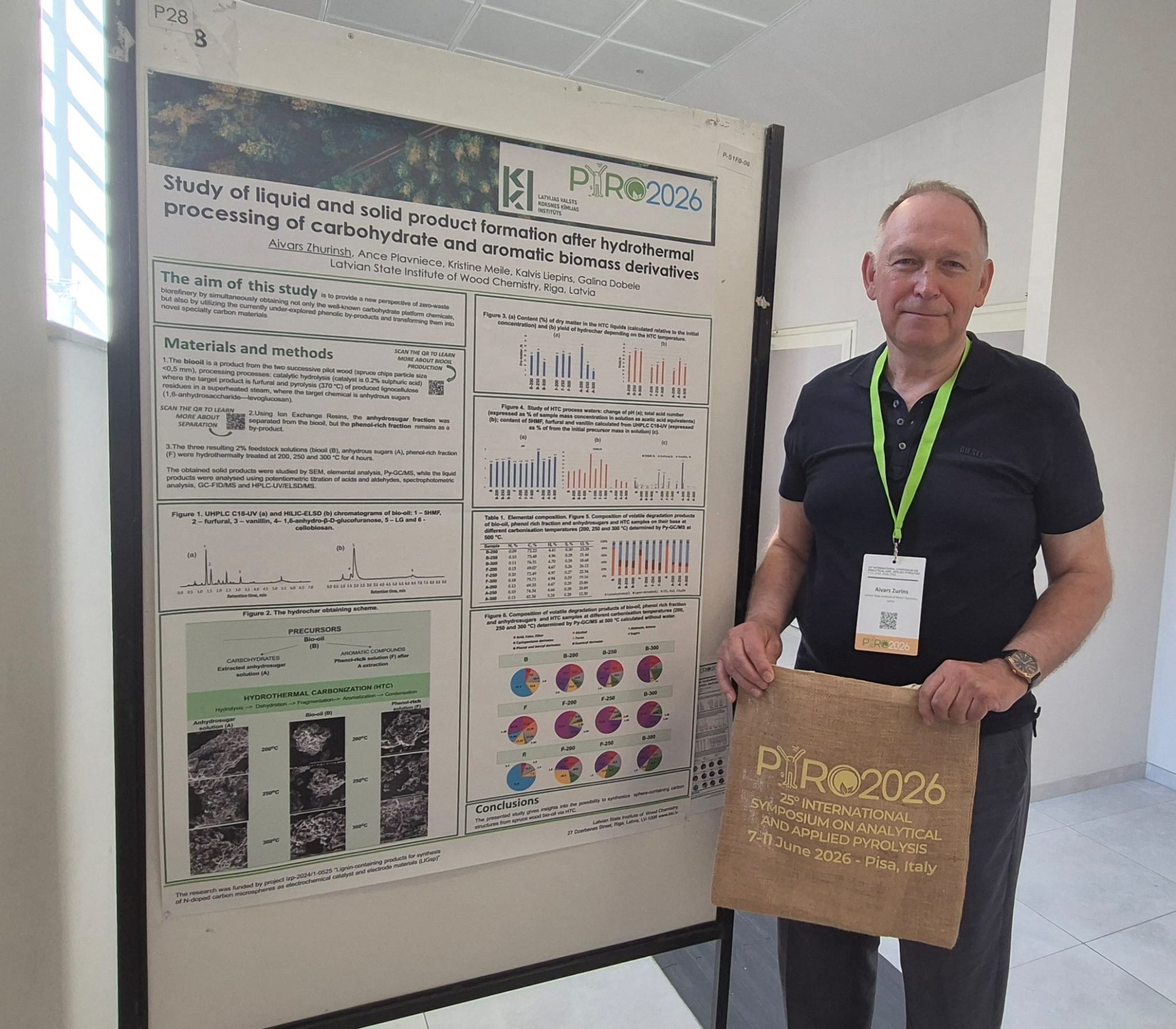
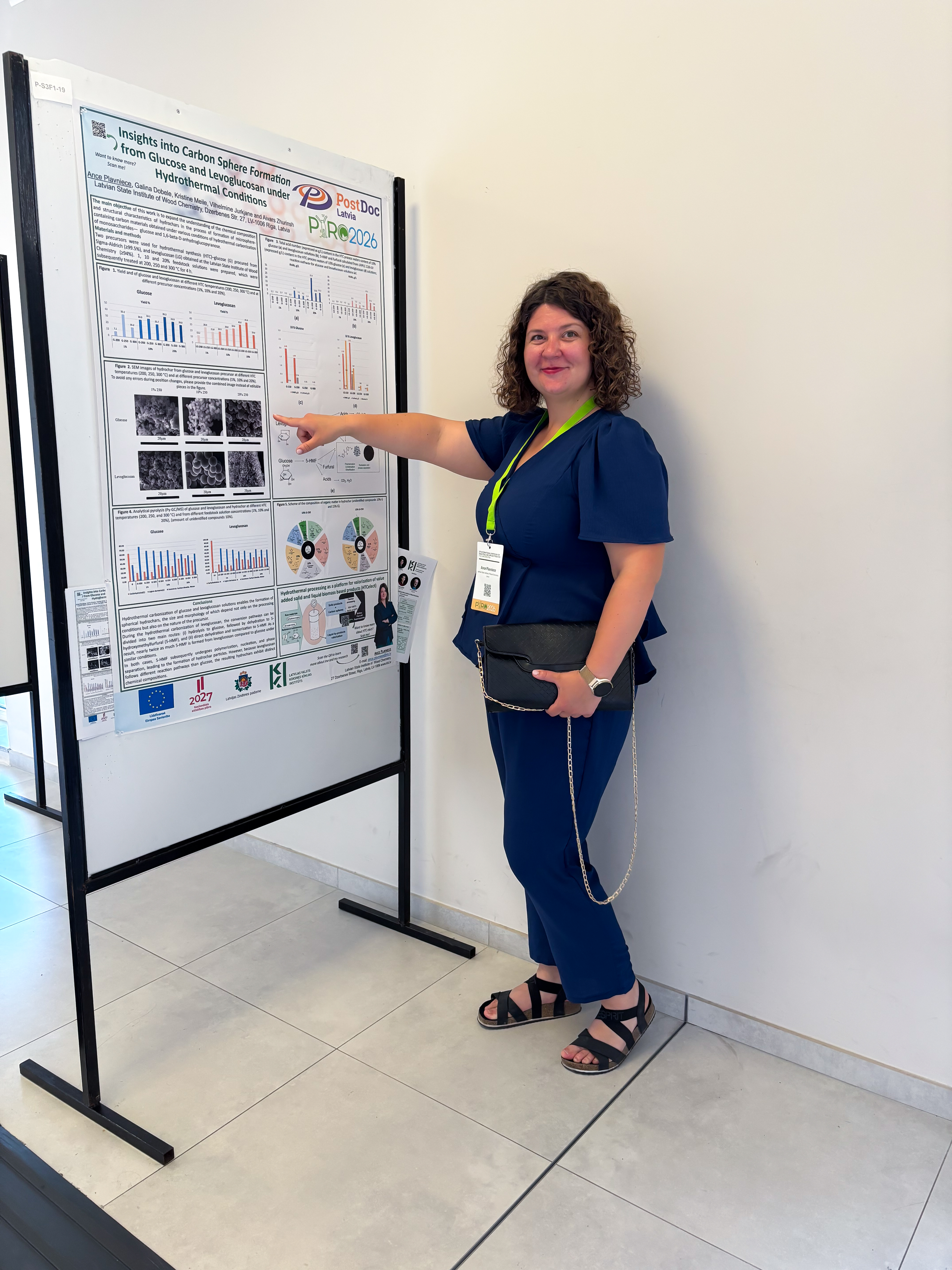
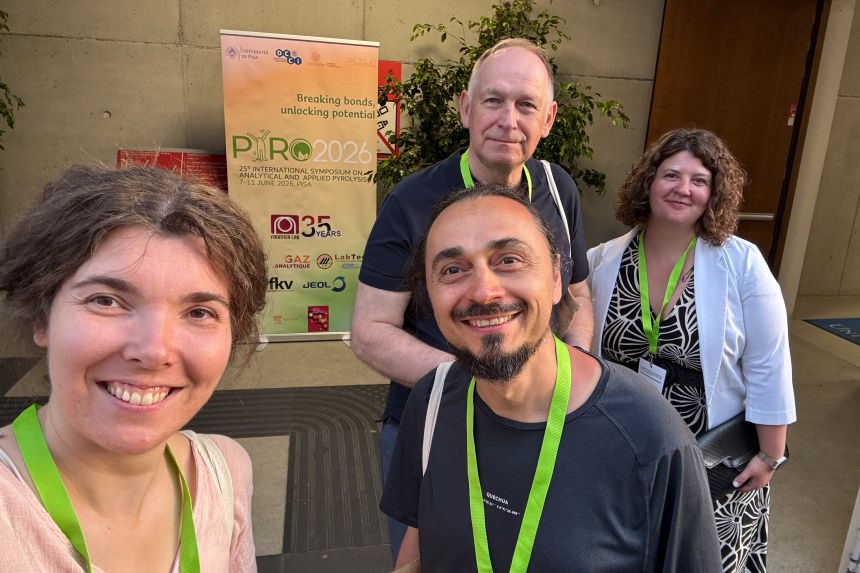
LSIWC was represented by Aivars Žūriņš, Ance Pļavniece, Aleksandrs Voļperts, and Kristīne Meile, who presented four research studies:
- Ance Pļavniece, Gaļina Dobele, Kristīne Meile – Comparative Study on the Hydrothermal Carbonization of Glucose and Levoglucosan: Understanding Carbon Sphere Formation Pathways;
- Aivars Žūriņš, Ance Pļavniece, Kristīne Meile, Kalvis Liepiņš, Gaļina Dobele – Study of Liquid and Solid Product Formation after Hydrothermal Processing of Carbohydrate and Aromatic Biomass Derivatives;
- Aleksandrs Voļperts, Ance Pļavniece, Gaļina Dobele, Aivars Žūriņš – Optimizing Activated Carbon Properties: The Role of Precursor Source, Carbonization and Activation Parameters;
- Kristīne Meile, Gaļina Dobele, Viktorija Jurkjāne, Aivars Žūriņš – Py-GC/MS Investigation of the Formation of Various Anhydrosugars from Carbohydrates for Efficient Green Chemical Synthesis.
The studies presented at the conference were carried out within the projects “SugarPot”, “ARMS”, “LIGsp”, and “HTCelect”. These projects cover both the investigation of biomass pyrolysis processes and the development of advanced carbon materials for environmental and energy-related applications, as well as the production of novel bio-based chemical compounds.
Participation in international conferences provides opportunities not only to present the latest research results, but also to strengthen cooperation with international partners, follow developments in the field, and establish new collaborative projects. At the same time, it demonstrates that thermochemical conversion research at LSIWC continues to evolve, combining decades of expertise with innovative solutions for the bioeconomy, green chemistry, and sustainable energy technologies.