Discussion at the National Library of Latvia: “Science Policy – a Springboard or a Setback for Latvia’s Growth?”
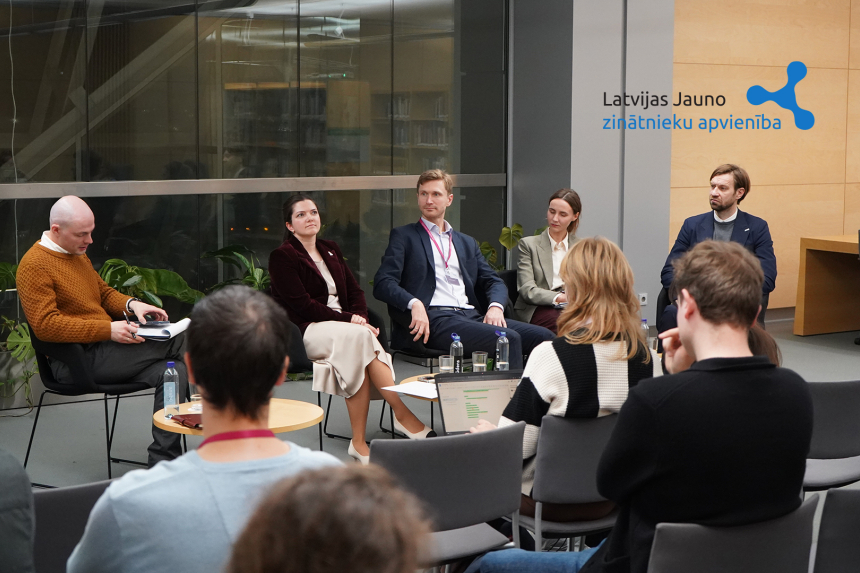
On October 28, the National Library of Latvia hosted the first of three discussions dedicated to the 20th anniversary of the Latvian Association of Young Researchers (LJZA). The discussion series, organized in cooperation with the National Library, focuses on the interaction between science and society, inviting reflection on how to make science a driving force for the country’s development.
The first discussion, titled “Science Policy – a Springboard or a Setback for Latvia’s Growth?”, brought together representatives from various fields — Professor Kristaps Jaudzems (University of Latvia), Antoņina Ņenaševa (Member of the 14th Saeima), Kaspars Gorkšs (Director General of the Latvian Employers’ Confederation), and Anna Leiškalne (representative of the Ministry of Education and Science). The discussion was moderated by Ingus Pērkons, LJZA Board Member and researcher at the Institute of Food Safety, Animal Health and Environment “BIOR”.
Science is one of the strongest driving forces of society and the economy, yet in Latvia, its potential remains underutilized. The panel sought answers to the question: how can science become a central, rather than marginal, national development priority? Participants examined both achievements and challenges that lie ahead. The discussion focused on creating a sustainable science human capital policy, where support for doctoral students and postdoctoral researchers becomes a long-term investment in the future rather than a short-term initiative. Participants also explored ways to foster a continuous dialogue between scientists and policymakers, ensuring that evidence-based decision-making becomes an integral part of national policy, including science policy itself. At the same time, they emphasized the need to change public and political perceptions of science as merely an immediate source of innovation, highlighting its role in strengthening security, health, and overall well-being.
LJZA Board Member and researcher at the Latvian State Institute of Wood Chemistry, PhD Daniela Godiņa, emphasized:
“The science policy system in Latvia is complex and, at the same time, fragile. Much has seemingly been done, yet we still lag behind other countries — suggesting that legislative changes and written strategies alone are not enough. What we need is a long-term approach based on trust and cooperation between scientists and policymakers. One of the key challenges is the renewal of the scientific workforce. The recent reforms in doctoral and postdoctoral systems are a step in the right direction, but they must become sustainable and predictable so that young researchers can see a clear career path rather than a temporary initiative. The academic career model should become a stable foundation that motivates young people to remain in science and continue their work in Latvia. And, of course, the question of fundamental science remains ever relevant — regarding research whose value cannot be measured solely in financial terms. We must find a balance between academic freedom and national priorities, between societal expectations and research independence. Only when this balance is achieved will science be able to fully serve public safety, health, and long-term development.”
The event was financially supported by the Society Integration Foundation. The next discussion will take place on November 26.
Follow updates on the Latvian Association of Young Researchers website: www.jauniezinatnieki.lv