An LSIWC research achievement among Latvia’s most significant scientific advances of 2025
The Latvian Academy of Sciences has announced the most significant scientific achievements in Latvia for 2025. A total of 55 submissions were evaluated across all major fields of science, and 12 works were selected as winners. Among them is a study carried out by researchers of the Latvian State Institute of Wood Chemistry (LSIWC), demonstrating a strong interplay between high-level fundamental and applied research, as well as close cooperation with industry.
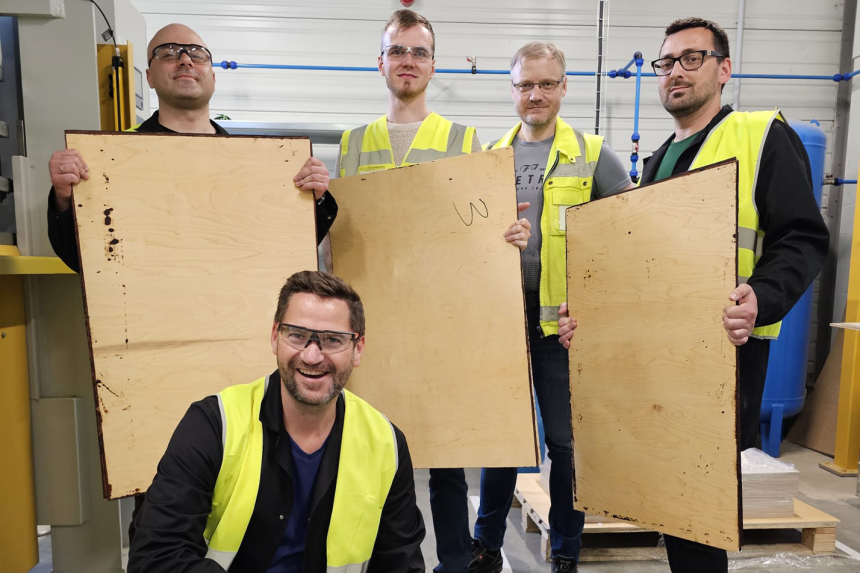
One of the most significant achievements of 2025 is the study “From Birch Bark to Sustainable Wood Materials: Suberinic Acid Innovations in the Circular Bioeconomy”. For the first time at an industrial scale, the authors have demonstrated that suberinic acids obtained through the depolymerisation of suberin can be successfully used as environmentally friendly binders in the production of moisture-resistant plywood, particleboard and fibreboard, as well as for wood surface coatings and impregnation.
The authors of the study are Dr. sc. ing. Jānis Rižikovs, Dr. sc. ing. Aigars Pāže, PhD Daniela Godiņa, MSc Rūdolfs Bērziņš, MSc Kalvis Liepiņš, MSc Guntis Sosins, together with industry representatives the team of AS “Latvijas Finieris”: Ainārs Bobulis, Artūrs Raimonds Feldmanis and Ketrina Plantus.
The significance of the work is confirmed by 15 scientific publications, a Best Paper Award in Materials Horizons, one patent, and one licence sold to AS “Latvijas Finieris” for the use of intellectual property rights. International cooperation with Stockholm University, NIBIO, INNORENEW, WULS, and VTT further highlights the relevance of this innovation at the European level.
According to the President of the Latvian Academy of Sciences, Ivars Kalviņš, this year’s awarded works demonstrate that Latvian science is increasingly integrating into the European and global research landscape, offering both conceptually novel solutions and results with direct benefits for society and the economy. In this context, the LSIWC achievement stands out for its clear industrial implementation and its sustainable impact on the wood processing sector.