How Heat Helps Bees Survive Winter: A Study on Hive Materials and Thermal Shielding
In December, when peace and frost prevail outside, the beehive only appears dormant. In reality, a continuous, quiet commotion is taking place inside. Bees cluster into a tight ball, vibrating their wings and muscles to maintain heat at the centre of the colony. At the core of the bee cluster, temperatures often reach 20–30 °C, which protects the queen.
This is one of nature's most sophisticated thermoregulation mechanisms. However, it is also very fragile. On winter days, when temperatures fluctuate rapidly, humidity spikes, or the outside frost penetrates too deeply, even a strong colony may collapse. That is why the microclimate within the hive is more than just a design question—it is essential for the survival of the bees.
As previously reported, within the framework of Latvian State Institute of Wood Chemistry (LSIWC) project "Development of a method for beehive shielding using thermoreflective surfaces to reduce bee losses under rapid climate change", our researchers are developing a solution to help reduce winter bee mortality by using thermoreflective surfaces for internal hive shielding and by creating new, environmentally friendly composite materials that combine the mechanical strength of wood with the thermal insulation properties of expanded polystyrene (EPS) hives.
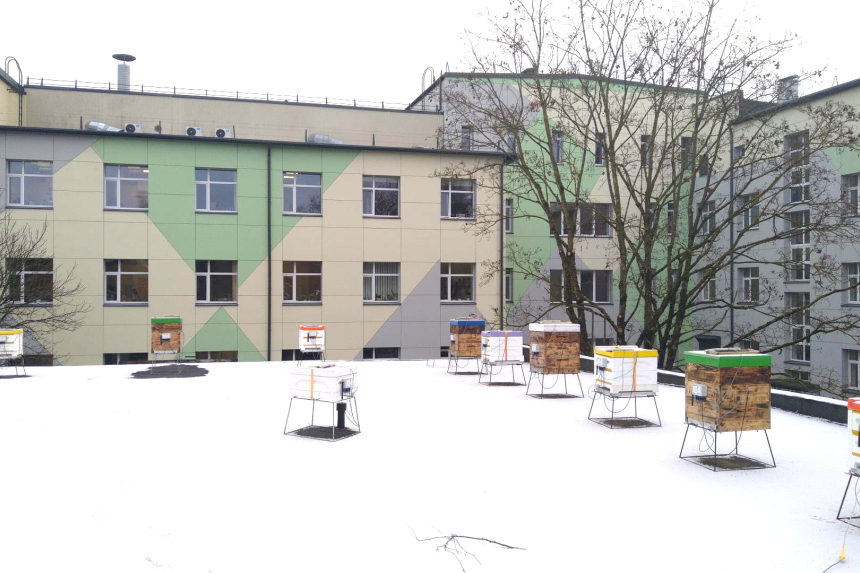
An experimental apiary with 36 hives has been established on the roof of the LSIWC. These hives are equipped with a sensor network that records hive weight, internal temperature, humidity, and external environmental parameters in real time. The project is led by our Cellulose Laboratory researcher, Dr. biol. Ulla Milbreta.
Each hive provides real-time information on:
- internal hive temperature,
- internal humidity,
- external environmental conditions,
- changes in hive weight.
This data stream enables a precise comparison of the behaviour of different materials and their effects on the bees' work in winter.
Why is this Project Necessary?
Bees ensure the pollination of more than 75% of food crops. Their health and stability affect not only the beekeeping industry but also the entire food system and natural plant diversity. In the context of climate change—characterised by warm winters, rapid temperature fluctuations, and frequent humidity spikes—the hive's ability to maintain a stable environment becomes critical.
Project Goals
The LSIWC, together with partners SIA Salix and SIA RS Bite, is working on an innovative approach to help bee colonies better adapt to modern climatic conditions. The project aims to create:
- thermoreflective surfaces for internal hive shielding, which reflect the heat generated by bees back into the hive, stabilising the microclimate,
- a new polyurethane–natural fibre composite material, combining the mechanical strength of wood with the thermal insulation of EPS hives.
The project will analyse complete bee life cycles over several seasons.
First winter observations
Dr. Ulla Milbreta reports the initial findings:
“At an outdoor temperature of –1 °C, temperatures ranging from 5 to 15 °C were recorded in various hive models. This range is significant: it indicates that the heat-reflecting properties of hive wall materials vary widely. While the temperature inside the bee cluster is naturally higher, these specific differences in sensor data allow us to understand which materials retain heat better, which release it rapidly, how shielding affects heat flow, and how the construction helps or hinders the bees' natural thermoregulatory mechanisms.”
In the coming months, these observations will be analysed alongside data on bee weight and activity, providing the first comprehensive insights into the impact of shielding.
A new hive material for the future
At the same time, LSIWC researchers Dr.sc.ing. Mārtiņš Andžs and Ph.D. Miķelis Kirpļuks are developing a new composite material that will combine:
- the mechanical strength of wood,
- the good thermal resistance and lightness of EPS,
- the porous structure of natural fibres.
Our researchers will carefully evaluate the material's heat capacity, thermal conductivity, and mechanical strength. Following laboratory testing, it will be used to manufacture a prototype hive for real-world verification. The project “Development of a method for beehive shielding using thermoreflective surfaces to reduce bee losses under rapid climate change” is implemented within the European Agricultural Fund for Rural Development and the CAP 2023–2027 programme (project No. 25-00-C0LA1602-000001).